
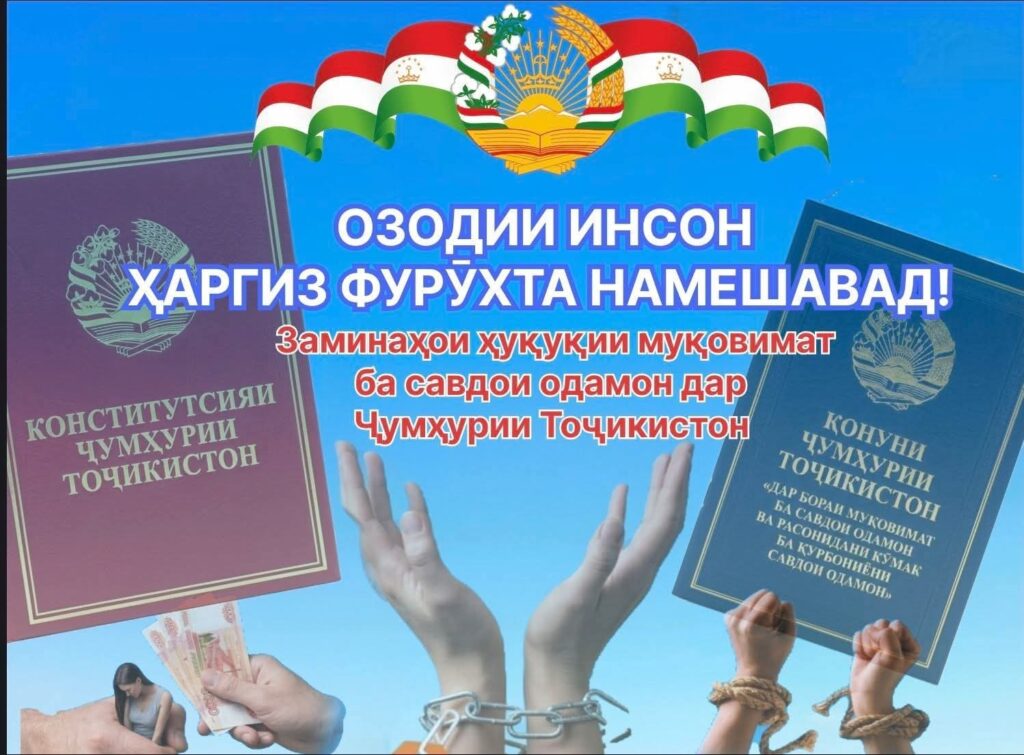
Human trafficking is one of the gravest and most disgraceful crimes of the modern era and is rightly considered one of the most dangerous phenomena of the century. This shameful act violates not only fundamental human rights, but also human dignity, honor, and freedom.
In the 21st century, when science and technology have reached remarkable heights, it is difficult to believe that people are still bought and sold as “commodities.” Combating this scourge of the century is not only the responsibility of law enforcement agencies, but also the duty of every member of society.
Human trafficking is the process of recruiting, transporting, and harboring people through violence, deception, or threats for the purpose of exploitation. Its most common forms include labor exploitation, sexual exploitation, psychological exploitation, and others.
Criminals and fraudsters often take advantage of people’s lack of awareness and economic difficulties, especially among young people. To lure citizens into becoming victims, they use common methods such as false promises of high-paying jobs abroad without requiring experience or language skills, online знакомствa through social networks to gain the trust of young people, confiscating passports and documents under the pretext of processing paperwork, and later demanding “service debts.” Through such methods, traffickers exploit victims for unlawful gain.
Typically, criminals force victims into hard labor in construction, agriculture, industry, begging, sexual exploitation, and other forms of abuse, grossly violating their rights and freedoms.
The international community is taking effective measures to combat this phenomenon by adopting legal acts, conducting public awareness campaigns, and imposing severe punishments on those involved in human trafficking.
As a full-fledged member of the international community, the Republic of Tajikistan attaches primary importance to the respect, protection, and guarantee of human and civil rights and freedoms. These principles are clearly enshrined in the Constitution of the country, which provides a solid legal foundation. In this regard, I would like to express my views concerning the legal foundations for ensuring human rights and freedoms in our country.
According to Article 5 of the Constitution of the Republic of Tajikistan:
“A person, his rights and freedoms are the highest value. Life, honor, dignity, and other natural human rights are inviolable. The state recognizes, observes, and protects human and civil rights and freedoms.”
In addition, Articles 14 and 18 of the Constitution state:
“Human and civil rights and freedoms are protected by the Constitution, the laws of the republic, and international legal acts recognized by Tajikistan… Restrictions on human and civil rights and freedoms are permitted only for the purpose of ensuring the rights and freedoms of others, public order, protection of the constitutional system, state security, national defense, public morality, public health, and the territorial integrity of the republic… Everyone has the right to life. No one shall be deprived of life except by a court sentence for an especially grave crime. The state guarantees the inviolability of the individual. No one shall be subjected to torture, punishment, or inhuman treatment. Subjecting a person to compulsory medical or scientific experiments is prohibited.”
This demonstrates the high level of legal protection enjoyed by individuals and citizens in the Republic of Tajikistan. On this basis, and in accordance with the humanitarian guidance of the President of the Republic of Tajikistan, the Leader of the Nation, esteemed Эмомалӣ Раҳмон, the national framework for combating human trafficking has been developed.
It should be noted that the Republic of Tajikistan is an active participant in the global process of combating human trafficking. Considering the threat posed by this disgraceful phenomenon to national security, the country adopted the Law “On Combating Human Trafficking” in 2004 and established the Interdepartmental Commission for Combating Human Trafficking in 2005.
Subsequently, several legal measures were implemented in this field. With the adoption of the Law of the Republic of Tajikistan “On Combating Human Trafficking and Providing Assistance to Victims of Human Trafficking” on July 26, 2014, the previous Law “On Combating Human Trafficking” of July 15, 2004, was repealed.
On July 10, 2014, the President of the Republic of Tajikistan, the Leader of the Nation, esteemed Эмомалӣ Раҳмон, stated during an expanded meeting of the Board of the Prosecutor General’s Office:
“Human trafficking committed by organized criminal groups is another factor undermining the stability, peace, and security of the country.”
Expressing concern about national honor, patriotism, conscience, and the Islamic morality of men and youth, the Leader of the Nation also stated:
“The history of our civilized nation has never known cases where young men took Tajik women abroad and sold them.”
The Law of the Republic of Tajikistan “On Combating Human Trafficking and Providing Assistance to Victims of Human Trafficking” (No. 1096 of July 26, 2014), consisting of 9 chapters and 48 articles, establishes the organizational and legal foundations for combating human trafficking, defines measures for the protection, assistance, and rehabilitation of victims, and regulates public relations in this sphere.
The main purpose of this Law is to establish and improve the effectiveness of the system for combating human trafficking by defining the legal and organizational foundations of state policy and international cooperation of the Republic of Tajikistan in this area, establishing general principles of legal liability for individuals and legal entities, determining the legal status of victims, guaranteeing their legal protection and support, and regulating the powers and cooperation of state bodies, public associations, and civil society institutions.
Based on the norms of this Law, state policy in the field of combating human trafficking and assisting victims has been clearly defined. In particular, 14 principles of state policy have been established, including the prioritization of the rights and legitimate interests of victims, state guarantees of their safety, protection of their life, health, honor, and dignity, confidentiality of personal data, prevention and detection of trafficking crimes, elimination of their consequences, protection and support of victims, prosecution of perpetrators, and prevention of repeat offenses.
The Law also guarantees state protection, restoration of victims’ rights, compensation for damages, ensuring their safety regardless of their behavior before the crime occurred, and regardless of their willingness to cooperate with law enforcement agencies during investigations and court proceedings. It also prohibits discrimination against victims, ensures humane and fair treatment, and guarantees free access to justice.
Furthermore, the Law defines the duties and powers of state bodies directly involved in combating human trafficking, as well as the competence of the Interdepartmental Commission and territorial commissions.
The Law also specifies preventive measures, including economic, social, legal, informational, educational, rehabilitation, and other initiatives aimed at identifying and eliminating the causes and conditions contributing to trafficking, identifying victims, facilitating their adaptation and social rehabilitation, and implementing special preventive measures through law enforcement agencies.
It is noteworthy that for the implementation of the Law “On Combating Human Trafficking and Providing Assistance to Victims of Human Trafficking,” as well as the Resolution of the Government of the Republic of Tajikistan dated July 24, 2025, No. 403 “On the National Plan for Combating Human Trafficking for 2025–2027,” and the Resolution of the Chairman of Sughd Region dated October 19, 2025, No. 308, a corresponding resolution of the Chairman of Buston city was adopted.
According to this resolution, a 27-point Action Plan for Combating Human Trafficking in Buston for 2026–2027 and the composition of the Territorial Commission on Combating Human Trafficking were approved.
For the implementation of these measures, 20,000 somoni were allocated from the local budget. Educational, informational, explanatory, and cultural activities are being organized throughout the city. Meetings and discussions involving city authorities, law enforcement leaders, activists, women, and youth have been conducted.
Additionally, preventive informational campaigns with the distribution of leaflets concerning national legislation on combating human trafficking and assisting victims are being carried out in markets, public places, educational institutions, and other locations by representatives of the Territorial Commission and the Ministry of Internal Affairs Department of Buston city.
In conclusion, I would like to emphasize that combating human trafficking begins with awareness. We must not remain indifferent to the fate of those around us.
Dear compatriots, if you witness any suspicious situation or if someone close to you has fallen victim to such a trap, immediately contact the relevant authorities, because:
HUMAN FREEDOM CAN NEVER BE SOLD!
Mamnur NURZODA
Deputy Chairman of Buston City,
Chairman of the Territorial Commission on Combating Human Trafficking in the City


